


The Best Public Golf Courses in the Pacific Northwest
Updated: Sep 21
The Pacific Northwest doesn't just have good muni golf, it's home to some of the best public golf in the entire country. From a former sand quarry that hosted a U.S. Open to a high desert layout carved out of lava rock, this region punches way above its weight when it comes to courses anyone can book a tee time on.
Here's how we'd rank the top 20.
20. Trail Creek Golf Course

Trail Creek is the crown jewel of the Sun Valley Resort in Idaho, one of the oldest ski-and-golf destinations in the American West, and it's been ranked Idaho's best course by Golf Digest more times than any other track in the state. Robert Trent Jones Jr. reworked the original 1937 layout in 1980, threading the namesake creek across the front nine seven separate times and building a stiffer, more dramatic back nine into the base of the Pioneer and Boulder mountain ranges, all under the watch of Bald Mountain. At roughly 6,000 feet of elevation the ball travels noticeably farther, which is a fun ego boost until the thin mountain air also makes club selection into the well-guarded, elevated greens a genuine guessing game. A memorial to Ernest Hemingway sits just off the 8th tee, a reminder of how long this stretch of Idaho has been drawing people in.
19. Suncadia Prospector

Prospector, the flagship course at the sprawling Suncadia Resort near Roslyn and Cle Elum, is the golf course that makes a lot of Seattleites feel like they've teleported to Bend without the drive. Laid out by the Arnold Palmer Design Company in 2005, it winds through dense pine and fir forest below the granite peaks of the Cascades' eastern slopes, with well-bunkered, rolling fairways and enough water to keep the more accomplished player honest, while still staying generous enough for the resort crowd to have fun. It's one of three courses on the Suncadia property, alongside the Peter Jacobsen-designed Rope Rider and the private, Tom Doak-designed Tumble Creek, and it consistently ranks among Washington's top 15 courses. It's an easy 90-minute drive from Seattle, which makes it one of the most convenient mountain golf trips in the state.
18. Glaze Meadow at Black Butte Ranch

Glaze Meadow, one of two courses at the Black Butte Ranch resort near Sisters, Oregon, is proof that a good renovation can turn a solid course into a genuinely great one. Gene "Bunny" Mason laid out the original in 1982, but it was a $3.75 million John Fought redesign in 2010-12 that elevated Glaze Meadow into a four-star Golf Digest "Best Places to Play." The routing starts in open meadowland with Cascade views — Black Butte and the Three Sisters both make appearances — before working its way into tall stands of ponderosa pine and fir for the back half. It's not the longest or hardest course on this list, but the conditioning is consistently excellent and the setting, tucked into a quiet residential resort community, is about as peaceful as Central Oregon golf gets.
17. The Home Course

The Home Course in DuPont carries a fitting nickname — "The Home of Golf in the Northwest" — as the only course in the country cooperatively owned and operated by two state golf associations, in this case the Pacific Northwest Golf Association and Washington Golf. Mike Asmundson's 2007 design sits on the site of a former DuPont dynamite plant south of Tacoma, and it delivers exactly what you'd hope from that pedigree: a walkable, fast-and-firm layout with sweeping views of Puget Sound, the Olympics, and Mount Rainier, plus greens with enough undulation to make the mid-round math genuinely tricky. It served as the companion course to Chambers Bay for the 2010 U.S. Amateur and hosted the 2014 U.S. Women's Amateur Public Links on its own, and it remains one of the best values for the quality of golf you're getting in the entire South Sound.
16. Gamble Sands (Scarecrow Course)

Scarecrow, which opened in August 2025 as the second course at Gamble Sands, proves David McLay Kidd had another great one left in him even after the wide-open, universally beloved Sands course. Built with longtime associate Nick Schaan on 300 acres of former farmland the Gebbers family once used to grow corn, Scarecrow climbs and plunges as much as 70 feet across holes, trading the original course's broad fairways and forgiving contours for tighter corridors, smaller and more aggressively shaped greens, and clifftop views straight down into the Columbia River valley. It's meaningfully harder than its sibling — Kidd himself has said as much — but it's every bit as fun, opening with a blind downhill par-4 and closing with a drivable par-4 played to a green perched right on the edge of a canyon. Golf Digest named it the Best New Public Course of 2025, the same honor the original Sands course won back in 2014, and together the two courses have officially turned Gamble Sands from a curiosity into a true destination.
15. Coeur d'Alene Resort Golf Course

You can't talk Northwest golf without talking about the Floating Green. The Coeur d'Alene Resort's par-3 14th is the only green of its kind in the world — a movable island that shifts along an underwater cable system so the hole plays a different yardage every day, and you take a private boat, the Putter, out to retrieve your ball and putt out. It's a legitimate gimmick, but Scott Miller's 1991 design earns its reputation beyond that one hole too, with a scenic, well-conditioned parkland routing along Lake Coeur d'Alene and Fernan Creek, a forecaddie included with every round, and a lake shuttle that ferries you from the hotel to the first tee. It's not the toughest test on this list — the emphasis is squarely on fun and spectacle over scoring difficulty — but for a bucket-list day of golf, it's hard to top.
14. Gold Mountain Golf Club (Olympic Course)

Gold Mountain in Bremerton is the best golf value in Washington not named Chambers Bay, and the Olympic Course is the reason why. John Harbottle III designed this municipal gem in 1996, cutting it through towering Pacific Northwest evergreens with the kind of significant elevation change and undulating, collection-area greens you'd expect from a much pricier private club. It's tough enough to have hosted the 2006 U.S. Amateur Public Links and a U.S. Junior Amateur that a teenage Jordan Spieth won, but the wide, generous driving corridors keep it playable for the rest of us — right down to a drivable par-4 18th that's a perfect way to settle a match. Add in a scenic ferry ride over from Seattle, and it's one of the easiest day trips in Northwest golf.
13. Pumpkin Ridge Golf Club (Ghost Creek)

Ghost Creek is the public half of one of the most storied 36-hole complexes in American golf — its sister course, the private Witch Hollow, is where a 20-year-old Tiger Woods won his third straight U.S. Amateur in 1996. But Ghost Creek stands entirely on its own. Bob Cupp and John Fought's 1992 design winds through the wooded, marshy foothills west of Portland, with the title creek slipping in and out of view and creating genuine risk-reward decisions on hole after hole, most famously the drivable-ish par-4 17th. It's hosted a U.S. Junior Amateur, a U.S. Girls' Junior, and years of LPGA and PGA Tour events, and it remains one of the best-conditioned, most complete public tests in the greater Portland area.
12. Salish Cliffs Golf Club

Salish Cliffs, the golf amenity at the Squaxin Island Tribe's Little Creek Casino Resort near Shelton, might be the least-known great course in Washington. Gene Bates — the same architect behind Circling Raven — was handed 320 acres of thick Pacific Northwest forest and 600 feet of elevation change, and the result is a secluded, immersive round where almost every hole feels carved entirely out of the trees. The bentgrass conditioning is consistently excellent, the greens are some of the truest-rolling in the state, and the shared double green on 9 and 18 is a great final flourish. It's the world's first Salmon-Safe certified golf course to boot, and it's earned real recognition — Golfweek named it the top new course in the country the year it opened.
11. Gearhart Golf Links

Gearhart, on the North Oregon Coast, is the oldest golf course west of the Mississippi River — golf has been played continuously on this ground since 1892. It's a genuine, old-world links experience: firm, sandy fairways, small undulating greens, salt air, and a persistent coastal wind that turns a short scorecard into a real test. A 2013–2015 restoration stripped out hundreds of pines that had crept in over the decades and opened the course back up to its original open, dune-land character, with the back nine delivering the ocean views. Add in the McMenamins-run Sand Bar for a post-round pint and the Clam Bed putting course out front, and Gearhart is as much a slice of Pacific Northwest golf history as it is a fun round.
10. Palouse Ridge Golf Club

Set right on the Washington State University campus in Pullman, Palouse Ridge is proof that a college course can hang with the big boys. The late John Harbottle III routed this 2008 design over rolling, nearly treeless wheat country on the edge of the Palouse, and the result plays like a slice of Scotland dropped into the Inland Northwest — firm turf, 49 bunkers, a couple of lakes, and views of the mountains of Idaho and Oregon from nearly every tee. As the home course of the WSU Cougars, it's built to test good players, with plenty of elevation change and a standout set of par-3s, but the wide, forgiving fairways mean weekend golfers can still have a blast. It's out of the way — Pullman isn't exactly on the way to anywhere — but it's one of the best college courses in the country and well worth the detour.
9. The Idaho Club

Perched along Lake Pend Oreille in Sandpoint, Idaho, The Idaho Club is Jack Nicklaus's toughest test in the region, and one of its most beautiful. Nicklaus reworked the old Hidden Lakes course in 2008, weaving holes through the wetlands of the Lower Pack River and up into the timber and rock formations of Moose Mountain, with the Selkirk range as a backdrop the entire way. Water comes into play on 16 of the 18 holes, forced carries are the norm, and there's little margin for a lazy swing — this is Nicklaus at his most demanding. It's technically semi-private, with public tee times available later in the day, but that's part of what keeps it playable and pristine. Bring extra balls and lower your scoring expectations; you're here for the golf course, not the scorecard.
8. Running Y Ranch Golf Course

Running Y, just outside Klamath Falls, is the only course Arnold Palmer ever designed in Oregon — and one Palmer himself named among his personal "Sweet Sixteen" favorites out of the 300-plus courses he built worldwide. The layout does double duty: the front nine plays like an open, links-style ramble around the Klamath Basin, while the back nine tightens up through pine forest and Payne Canyon. It's a genuinely fun, scorable course with Palmer's signature curvy, receptive fairways, and the full resort experience — lodging, restaurants, a sports center — makes it an easy home base for a Southern Oregon golf trip, especially with Crater Lake just up the road.
7. Silvies Valley Ranch (Craddock Course)

Silvies is unlike anything else on this list, or in golf, period. Set on a 140,000-acre working cattle and goat ranch in the high desert of eastern Oregon, architect Dan Hixson built two reversible 18-hole courses — Craddock and Hankins — that share nine greens and swap direction depending on the day. Add in nearly 5,000 feet of elevation, wide fescue fairways, over a hundred bunkers built from sand sourced right off the ranch, and (yes) a herd of trained goat caddies on the short course, and you've got one of the most singular golf experiences in the country. It's remote — figure three hours from Bend or Boise — but that isolation is the point: you'll rarely see another group all day, and the lodge, food, and service are all first-rate.
6. Wine Valley Golf Club

Wine Valley, just outside Walla Walla, is the course that put Dan Hixson on the map, and it still holds up as one of the best inland links experiences in the country. Built on rolling, glacially-formed wheat and alfalfa ground with the Blue Mountains as a backdrop, it's wide-open, firm, and fast, with massive fairways that give every golfer multiple ways to attack a hole — the challenge is almost entirely in the wildly contoured greens and the wind, since there's no tree cover to hide from either. Golf Digest ranks it among Washington's best courses year after year, and it's an easy pairing with a weekend in wine country: play in the morning, taste Cabernets and Syrahs in the afternoon.
5. Circling Raven Golf Club

Tucked into 620 acres of rolling Palouse hills at the Coeur d'Alene Casino Resort in Worley, Idaho, Circling Raven is the kind of course that makes you forget you're on a tee sheet at all. Designed by Gene Bates in partnership with the Coeur d'Alene Tribe, the layout swings from golden prairie to pine-lined corridors to wetlands crossed by North Fork Rock Creek, all without a house in sight. It's a long test from the tips at just under 7,200 yards, but the fairways are generous enough that mid-handicappers won't get beat up. Add in a top-tier practice facility, a laid-back casino resort right next door, and green fees that are still a relative bargain, and it's easy to see why Golfweek has repeatedly named it Idaho's best public course.
4. Gamble Sands (Sands Course)

Perched on a sandy plateau above the Columbia River in Brewster, Washington, Gamble Sands is David McLay Kidd's love letter to fun golf. Golf Digest named it Best New Course in 2014, and it's easy to understand why: the fescue fairways are absurdly wide, the greens are enormous punchbowls and backstops, and the "friendly contours" funnel even mediocre shots back toward the target. There's essentially no rough and barely a lost ball to be found, which means low-handicappers can go low and everyone else can post a career round. It's a haul to get there — figure four-plus hours from Seattle — but between the golf, the Columbia River views, and the burgers at Danny Boy's, it's one of the most purely enjoyable rounds in the entire Northwest.
3. Pronghorn Golf Club (Nicklaus Course)
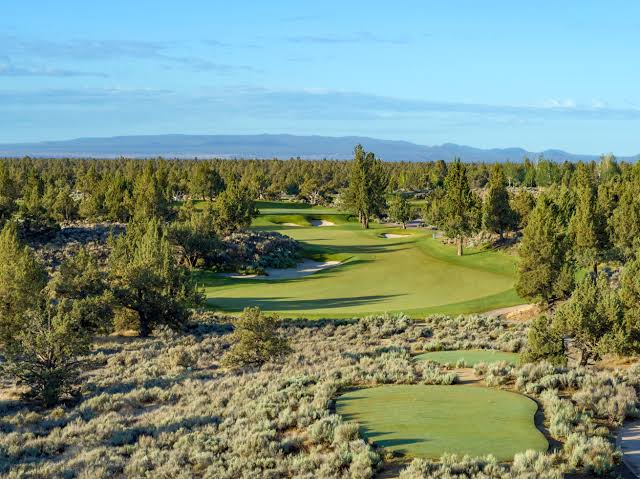
Oregon's only Jack Nicklaus signature design sits on 640 acres of BLM high desert north of Bend, at the heart of the Juniper Preserve resort. Ancient lava rock outcroppings, juniper forest, and framed views of Mt. Bachelor, Broken Top, and the Three Sisters give the course a raw, prehistoric character you won't find anywhere else in the region. It's deceptively tough — tight tee shots, multi-level greens, and a real premium on accuracy over raw distance — but the conditioning is some of the best you'll find at any public course in the country. A regular on Golf Digest's list of America's 100 Greatest Public Courses, Pronghorn delivers a private-club experience without a membership requirement, right down to the forecaddies and the resort-level service.
2. Tetherow

Tetherow is Bend's most polarizing golf course, and that's exactly the point. David McLay Kidd built this Scottish heathland-style layout in 2008 on land scarred by an old forest fire, and the result is all fescue, all the time — rugged bunkering, blind tee shots, and green complexes with more movement than almost anything else in Central Oregon. Golfers tend to either love the challenge or leave frustrated by three-putts they never saw coming, but nobody argues with the views: the Cascades, including Three Sisters and Broken Top, loom over nearly every hole. It rewards repeat visits as you learn where to miss and how to read the ground game, and it remains one of the most distinctive, memorable rounds anywhere in the Northwest.
1. Chambers Bay

There's a reason Chambers Bay tops this list — it's the only public course in the region actually built to host a U.S. Open, and it delivers on that scale every time you play it. Carved out of an abandoned sand and gravel quarry on the shores of Puget Sound, Robert Trent Jones Jr.'s 2007 design is a true links course: firm, fast fescue and poa fairways, cavernous bunkers, a single tree on the entire property, and greens that demand a completely different kind of imagination than anything else in the Northwest. It's walking-only, and the terrain makes it one of the toughest walks in golf, but that's part of the pilgrimage. Add in sweeping views of the Sound, the rumble of the BNSF line running along the water, and the history of hosting the 2010 U.S. Amateur and 2015 U.S. Open, and you've got a genuine bucket-list round that happens to be open to the public. If you only play one course on this list, make it this one.


Comments